
Over the past few years I’ve built several sports-related projects, ranging from simple score widgets to full tennis analytics platforms. One of the questions I get asked most often by developers is surprisingly not about tennis APIs themselves, but about the development platform that should be used alongside them.
There are now more development tools available than ever before. Developers can choose between React, Next.js, Flutter, Bubble, Laravel, Django, Node.js, .NET, Supabase, Firebase, Vercel, and dozens of other frameworks and platforms.
After experimenting with most of them while building tennis data applications, I’ve reached a fairly clear conclusion: for most tennis API projects, a modern React and Next.js stack provides the best overall balance of development speed, scalability, performance, SEO, and user experience.
This article shares my experience building tennis applications, what worked well, what didn’t, and why I believe certain platforms are particularly well suited for tennis data projects.
The Problem With Sports Data Projects
Building sports applications differs from building many other types of software.
A standard business application might display static information that changes occasionally.
Tennis applications are completely different.
They often require:
- Live scores
- Rankings
- Historical match data
- Head-to-head statistics
- Tournament results
- Player profiles
- Performance analytics
- Search functionality
- Real-time updates
This creates unique technical challenges.
You’re not simply displaying information.
You’re processing and presenting constantly changing datasets.
The development platform you choose can make a huge difference.
My First Attempt
Several years ago, I built a basic tennis statistics site using traditional PHP and a MySQL database.
At the time it seemed like the obvious choice.
The site worked, but it quickly became difficult to maintain.
Every new feature required additional complexity.
Performance became an issue as the database grew.
User interactions felt slow compared with modern web applications.
Most importantly, building rich interactive experiences required significantly more effort than I expected.
That experience taught me an important lesson.
Sports applications benefit enormously from modern front-end frameworks.
Why Tennis APIs Changed Everything
When I first started building sports software, obtaining data was often harder than building the application itself.
Today that situation has completely changed.
Modern tennis APIs provide access to:
- ATP rankings
- WTA rankings
- Match history
- Head-to-head records
- Player statistics
- Tournament calendars
- Historical results
- Live scores
For example, one of the most comprehensive tennis datasets I’ve worked with is discussed here:
https://matchstat.com/predictions-tips/the-best-tennis-data-api-for-stats/
With high-quality data readily available, the focus shifts from data collection to product development.
That’s where platform choice becomes important.
Why I Eventually Chose Next.js
After experimenting with various options, I found myself repeatedly returning to Next.js.
For tennis projects specifically, it solved several major problems.
SEO Benefits
Many tennis applications depend heavily on search traffic.
Users search for:
- Player statistics
- Head-to-head records
- Rankings
- Tournament results
- Match previews
Traditional single-page applications often struggle with SEO.
Next.js generates pages that search engines can crawl more effectively.
For content-heavy tennis websites, this becomes a major advantage.
Fast Page Loading
Sports users are impatient.
If a rankings page takes five seconds to load, users leave.
Next.js allows pages to load extremely quickly, especially when combined with modern hosting platforms.
This significantly improves user experience.
Easy API Integration
Most tennis APIs return JSON.
Next.js works naturally with JSON-based APIs.
Fetching rankings, match history, player profiles, and tournament information becomes straightforward.
During development I found I could build new pages rapidly because the framework handled much of the complexity.
React Makes Tennis Apps Feel Modern
While Next.js handles the framework layer, React provides the interactive experience.
This is where modern sports applications really shine.
React makes it easy to build:
- Live scoreboards
- Rankings tables
- Player comparison tools
- Search interfaces
- Analytics dashboards
- Interactive charts
Users increasingly expect these types of features.
Static websites feel outdated compared to modern sports platforms.
React helps create the responsiveness that users now expect.
Why Firebase Surprised Me
One platform I initially underestimated was Firebase.
For smaller tennis projects, Firebase can be incredibly useful.
Features include:
- Authentication
- Databases
- Hosting
- Real-time updates
- Analytics
Many developers spend weeks building infrastructure that Firebase provides immediately.
For MVPs and startup projects, this can dramatically reduce development time.
If I were launching a new tennis startup today, Firebase would likely be part of the stack.
Supabase Is Becoming a Serious Alternative
Recently I’ve also spent time working with Supabase.
Many developers describe it as an open-source alternative to Firebase.
For tennis projects, Supabase offers several advantages:
- PostgreSQL database
- Authentication
- Storage
- Real-time capabilities
- SQL flexibility
Because sports applications often involve large datasets, I appreciate having direct access to a powerful relational database.
Complex tennis queries become much easier.
The Rise of AI-Assisted Development
One of the biggest changes in recent years has been AI coding tools.
Platforms such as:
- ChatGPT
- Claude
- GitHub Copilot
have fundamentally changed how software is built.
When creating tennis applications, AI tools can help generate:
- API integrations
- Front-end components
- Database schemas
- Search functionality
- Data visualizations
Tasks that previously required hours can often be completed in minutes.
This has significantly reduced development time for many of my projects.
What About No-Code Platforms?
Many people ask whether no-code tools are suitable for tennis applications.
Platforms like Bubble can absolutely work.
For simple projects, they offer impressive capabilities.
However, once you start dealing with:
- Large datasets
- Live scores
- Thousands of player profiles
- Historical match records
- Advanced analytics
the limitations become more apparent.
For serious tennis applications, I generally prefer traditional development frameworks.
They offer more flexibility and scalability.
The Importance of Hosting
Development frameworks often receive all the attention, but hosting is equally important.
For Next.js applications, Vercel has become my preferred choice.
Deployment is simple.
Performance is excellent.
Scaling is straightforward.
The combination of:
- Next.js
- React
- Vercel
creates a development experience that feels remarkably smooth.
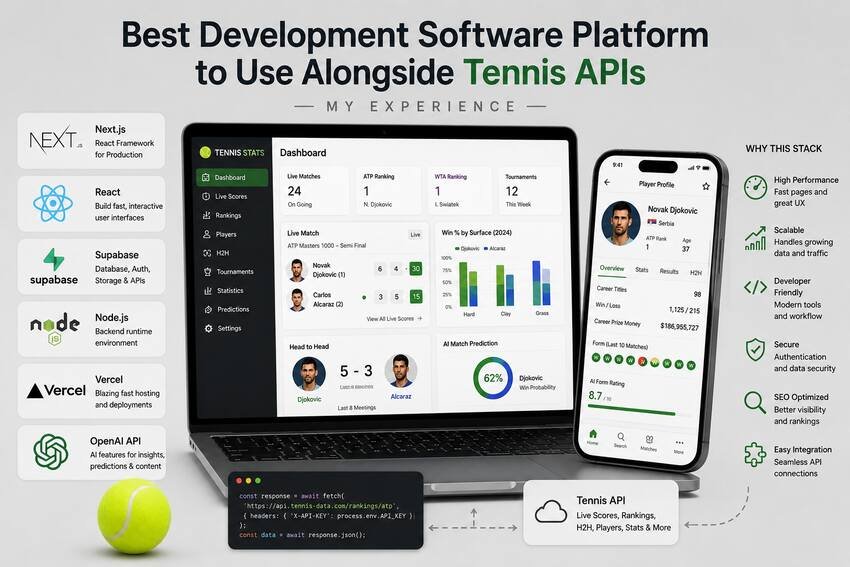
My Current Tennis Stack
If I were starting a new tennis statistics platform today, my stack would likely look like this:
Front End
- React
- Next.js
Back End
- Node.js
Database
- PostgreSQL
- Supabase
Hosting
- Vercel
Authentication
- Supabase Auth
AI Features
- OpenAI APIs
Data Source
- Tennis API
This combination provides flexibility, scalability, and excellent developer experience.
Most importantly, it allows me to focus on building features rather than fighting infrastructure.
Lessons Learned
After building multiple sports and tennis-related projects, several lessons stand out.
Keep The Stack Simple
Developers often overcomplicate projects.
A simple stack usually wins.
Choose Data First
The quality of the tennis data matters more than the framework.
Without good data, no amount of engineering can save the product.
Prioritize Speed
Sports users expect information immediately.
Performance should never be an afterthought.
Think About SEO Early
Many sports websites depend heavily on organic traffic.
The platform should support this from the beginning.
Use Modern Tools
The development landscape has improved dramatically.
Modern frameworks allow developers to build products much faster than before.
Final Thoughts
There has never been a better time to build sports applications.
High-quality tennis APIs have made data more accessible than ever, while modern development platforms have dramatically reduced the complexity of creating sophisticated products.
After experimenting with numerous frameworks and platforms, my preferred combination remains React, Next.js, Supabase, and Vercel alongside a comprehensive tennis data provider.
This stack provides an excellent balance between development speed, performance, scalability, and user experience.
Most importantly, it allows developers to spend less time worrying about infrastructure and more time creating features that tennis fans actually care about.
Whether you’re building a rankings platform, player comparison tool, prediction engine, analytics dashboard, or full-scale tennis statistics website, choosing the right development platform can make the difference between a project that struggles and one that scales successfully.
In my experience, modern React-based development paired with a comprehensive tennis API is currently one of the most effective combinations available for building serious tennis software.