
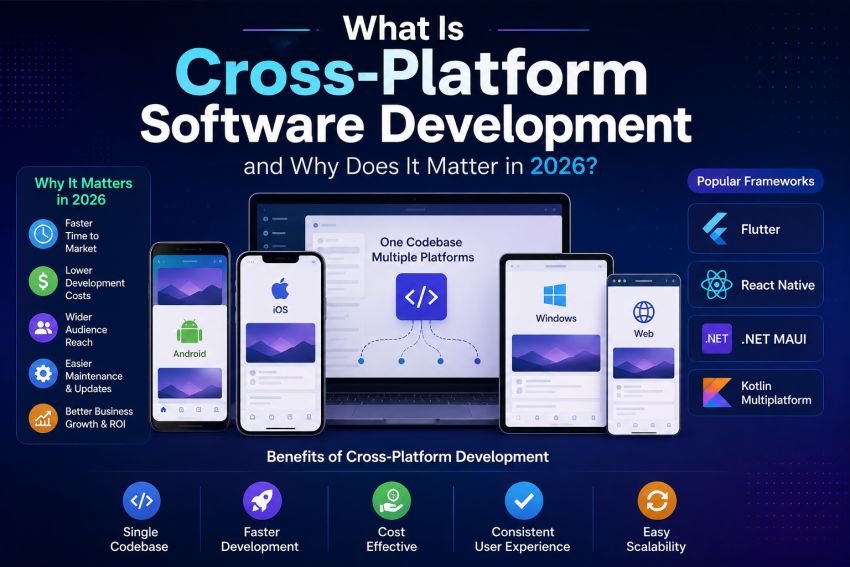
Modern businesses want applications that work smoothly across multiple devices without spending time and money building separate apps for every platform. Whether it’s Android, iOS, Windows, or the web, users expect the same fast and reliable experience everywhere. This growing demand has made cross-platform development one of the most important software development approaches in recent years.
If you’ve ever wondered what is cross-platform software development, you’re not alone. Companies of all sizes are investing in this development method because it reduces costs, shortens development time, and helps reach a wider audience.
In this guide, you’ll learn how cross-platform software development works, its advantages, challenges, popular frameworks, and why it continues to play a major role in 2026.
What Is Cross-Platform Software Development?
Cross-platform software development is the process of creating a single application that can run on multiple operating systems using one shared codebase.
Instead of writing separate applications for Android, iOS, Windows, or macOS, developers write most of the code once and deploy it across different platforms with only minor adjustments where necessary.
This approach helps businesses launch products faster while maintaining a consistent user experience.
For example, a shopping app developed using a cross-platform framework can work on both Android and iPhone without requiring two completely different development teams.
Why Cross-Platform Development Matters in 2026
Technology continues to evolve rapidly, and users now interact with businesses through smartphones, tablets, desktops, smart TVs, and even wearable devices.
Businesses can no longer afford to focus on only one operating system.
Cross-platform development has become increasingly valuable because it helps organizations:
- Reach more customers
- Reduce development expenses
- Speed up product launches
- Simplify software maintenance
- Deliver consistent branding
In today’s competitive market, faster releases often provide a major competitive advantage.
How Cross-Platform Development Works
Instead of maintaining separate codebases, developers use specialized frameworks that translate one programming language into applications compatible with multiple operating systems.
These frameworks provide built-in components that adapt automatically to different devices while preserving native functionality.
The result is an application that feels familiar to users regardless of the platform they’re using.
Popular Cross-Platform Development Frameworks
Several mature frameworks dominate the industry in 2026.
Flutter
Developed by Google, Flutter uses the Dart programming language and offers excellent performance with attractive user interfaces.
It is especially popular for startups and businesses that want visually appealing applications.
React Native
Created by Meta, React Native allows developers to build mobile applications using JavaScript and React.
It remains one of the most widely adopted frameworks for commercial mobile applications.
.NET MAUI
Microsoft’s .NET MAUI enables developers to create applications for Windows, Android, macOS, and iOS from a single project.
It works particularly well for enterprise software.
Kotlin Multiplatform
Kotlin Multiplatform allows developers to share business logic across platforms while still building native interfaces where needed.
This hybrid approach combines flexibility with native performance.
Cross-Platform vs Native Development
| Feature | Cross-Platform Development | Native Development |
|---|---|---|
| Codebase | Single shared codebase | Separate code for each platform |
| Development Cost | Lower | Higher |
| Development Time | Faster | Longer |
| Maintenance | Easier | More complex |
| Performance | Very good for most apps | Best possible performance |
| Best For | Business apps, eCommerce, startups | Gaming, graphics-intensive apps |
Both approaches have advantages, but cross-platform development is often the smarter choice for businesses focused on speed and budget.
Major Benefits of Cross-Platform Software Development
Lower Development Costs
One development team can build applications for multiple operating systems.
This reduces staffing requirements and lowers overall project expenses.
Faster Time to Market
Launching an app quickly is often critical for business success.
Since developers only maintain one primary codebase, projects move from planning to release much faster.
Easier Maintenance
Updating multiple applications separately can become expensive and time-consuming.
Cross-platform apps only require one core update, making maintenance much simpler.
Consistent User Experience
Customers expect familiar layouts regardless of the device they use.
Shared code helps maintain consistent navigation, branding, and features across platforms.
Broader Market Reach
Publishing apps on Android and iOS simultaneously increases visibility and helps businesses reach millions of additional users.
Challenges of Cross-Platform Development
Although cross-platform development offers many advantages, it also comes with certain limitations.
Performance Differences
Highly demanding applications such as 3D games may still perform better when developed natively.
Platform-Specific Features
Some hardware features become available on one operating system before another.
Developers occasionally need custom native code to support new device capabilities.
Framework Dependency
Applications rely on external frameworks that require regular updates and long-term support.
Choosing a well-established framework minimizes this risk.
Industries That Benefit Most
Cross-platform development is widely used across many industries.
Examples include:
- Healthcare applications
- Banking apps
- Educational platforms
- Food delivery services
- Online shopping apps
- Travel booking platforms
- Business management software
- Customer relationship management (CRM) systems
Many organizations prioritize rapid deployment over platform-specific customization, making cross-platform development an excellent fit.
Practical Example
Imagine a startup launching a fitness application.
Instead of hiring separate Android and iOS developers, the company builds one application using Flutter.
The shared codebase allows both versions to launch simultaneously.
Whenever developers introduce new workout plans or fix bugs, both platforms receive updates at the same time.
This approach saves money while providing users with the same experience regardless of device.
Tips for Choosing Cross-Platform Development
Before starting your project, consider these recommendations:
- Clearly define your project goals.
- Choose a framework with strong community support.
- Prioritize security from the beginning.
- Test applications on multiple devices regularly.
- Optimize performance for older smartphones.
- Plan for future scalability.
- Work with experienced developers familiar with your chosen framework.
Good planning helps avoid expensive redesigns later.
Future Trends in Cross-Platform Development
The future looks promising for cross-platform software development.
Several trends are expected to shape the industry throughout 2026 and beyond:
- AI-assisted coding tools speeding up development
- Better integration with cloud services
- Stronger cybersecurity features
- Improved support for wearable devices
- Expanded desktop application capabilities
- Faster rendering engines
- Enhanced support for foldable smartphones
As frameworks continue improving, the performance gap between native and cross-platform applications is becoming smaller each year.
Conclusion
Understanding what is cross-platform software development is increasingly important for businesses planning digital products in 2026. Rather than maintaining separate applications for every operating system, organizations can build a single solution that reaches users across multiple platforms while reducing costs and development time.
Whether you’re launching a startup, expanding an existing business, or modernizing enterprise software, cross-platform development offers an efficient path to faster deployment and broader customer reach. By selecting the right framework, following best practices, and focusing on user experience, businesses can create high-quality applications that remain competitive in today’s rapidly evolving digital landscape.
FAQs:
1. What is cross-platform software development?
Cross-platform software development is the process of building one application that works on multiple operating systems using a shared codebase.
2. Is cross-platform development better than native development?
It depends on your project. Cross-platform development is ideal for most business applications because it reduces cost and development time, while native development is often preferred for high-performance games and graphics-intensive apps.
3. Which framework is best for cross-platform development?
Popular choices include Flutter, React Native, .NET MAUI, and Kotlin Multiplatform. The best option depends on your project requirements, budget, and development team.
4. Is cross-platform development suitable for startups?
Yes. Startups often choose cross-platform development because it allows them to launch products faster and reach Android and iOS users without doubling development costs.
5. Can cross-platform apps access device features?
Yes. Modern frameworks support most device features, including cameras, GPS, notifications, Bluetooth, and biometrics, with native integrations when necessary.
6. Are cross-platform apps secure?
Yes. When developed using secure coding practices, encryption, authentication, and regular updates, cross-platform applications can provide a high level of security.
7. Will cross-platform development continue growing after 2026?
Yes. As businesses increasingly prioritize faster releases, cost efficiency, and wider platform support, cross-platform software development is expected to remain one of the leading approaches for building modern applications.