

Growing a business often means building better digital products, improving internal processes, and responding quickly to changing customer needs. However, finding the right developers and managing a growing technology workload can become difficult, especially when a company does not have enough in-house technical talent.
This is where a dedicated development model can make a difference. A dedicated software development team in New York can give growing businesses access to developers, designers, testers, project managers, and other specialists who work together on specific technology goals. Instead of hiring every specialist as a permanent employee, businesses can build a focused team around their project requirements.
For companies operating in New York’s competitive business environment, this approach can provide flexibility while keeping software development aligned with business objectives.
What Is a Dedicated Software Development Team?
A dedicated software development team is a group of technology professionals assigned to work on a company’s software project or long-term technology needs.
The team may include:
- Software developers
- UI/UX designers
- Quality assurance engineers
- Project managers
- Business analysts
- DevOps specialists
- Cloud engineers
- Security specialists
The exact structure depends on the project. A small company developing a mobile application may need only a few developers, a designer, and a QA specialist. A larger enterprise platform may require a much broader team.
The important point is that the team is organized around the client’s goals rather than being a general pool of developers working on unrelated projects.
Why Growing Businesses Need Flexible Development Resources
Technology requirements can change quickly as a company grows. A business may begin with a simple website and later need a mobile application, customer portal, payment system, analytics dashboard, or customized business software.
Hiring permanent employees for every new requirement can take significant time and money.
Recruitment involves advertising positions, interviewing candidates, checking technical skills, negotiating salaries, onboarding employees, and providing equipment and benefits. Even after hiring, a company may discover that it needs a different skill set six months later.
A dedicated team offers another option. Businesses can adjust the size and skills of their development team as their requirements change.
Scaling the Team as the Project Grows
Consider a growing online retailer. Initially, it may need three developers to create a new shopping platform. As the platform becomes more complex, the company may add QA engineers, DevOps professionals, and additional developers.
Instead of rebuilding the entire development structure, the business can expand the team according to its priorities.
This flexibility can be particularly useful for startups and growing companies that need to control technology spending while continuing to develop new products.
Key Benefits of a Dedicated Development Team
Better Focus on Business Goals
A dedicated team can concentrate on one company’s product, platform, or technology objectives. Developers become familiar with the project’s architecture, business rules, users, and technical challenges.
Over time, this knowledge can reduce the need to repeatedly explain the same requirements to new developers.
The team can also work closely with company leadership and product managers, helping technical decisions remain connected to business priorities.
Access to Specialized Skills
Modern software projects often require several different skills. A single developer may not be an expert in cloud infrastructure, cybersecurity, mobile development, databases, and user experience.
A dedicated team allows businesses to combine different specialists.
For example, a fintech company developing a customer application may need backend developers, mobile developers, security professionals, QA engineers, and cloud specialists. Building all of these capabilities internally may be difficult for a smaller organization.
Greater Development Flexibility
Business requirements do not always remain fixed.
A company may decide to add a new feature, change its user interface, integrate another service, or move part of its infrastructure to the cloud.
With a dedicated team, resources can potentially be reorganized around these changing priorities.
This does not mean every change should be made immediately. Good project management is still important. However, having an adaptable team makes it easier to respond when priorities change.
Long-Term Product Knowledge
One of the hidden benefits of a stable development team is accumulated knowledge.
Developers who remain involved with a product understand why certain technical decisions were made. They become familiar with existing code, integrations, databases, deployment processes, and known limitations.
This knowledge can make future maintenance and improvements easier.
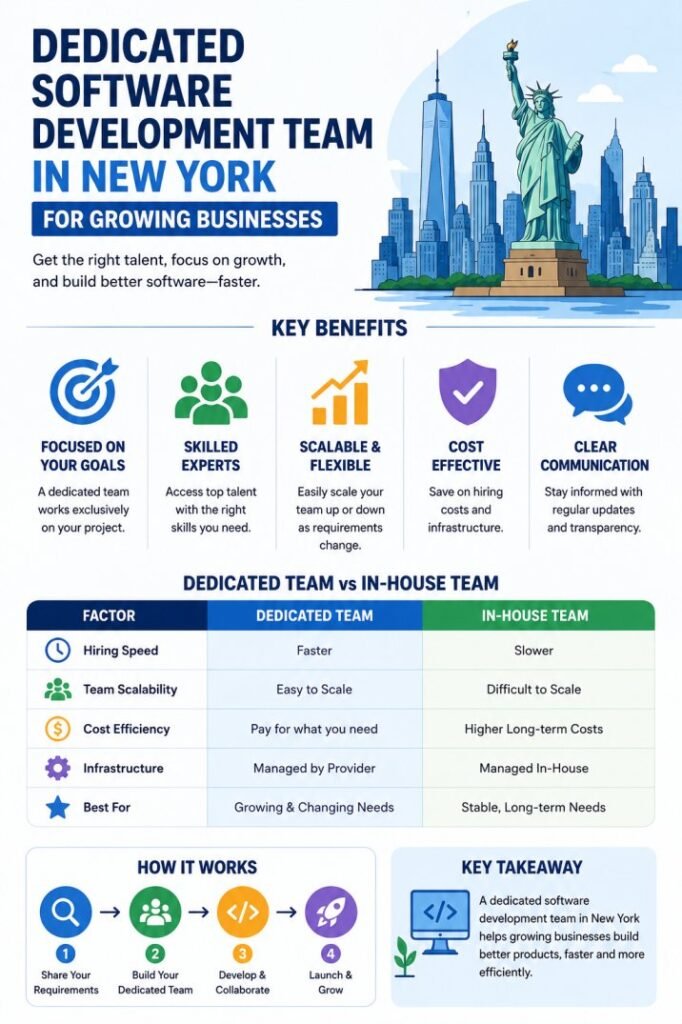
Dedicated Team vs. In-House Development
Both approaches can work well. The right choice depends on the company’s goals, budget, timeline, and available technical resources.
| Factor | Dedicated Development Team | In-House Team |
|---|---|---|
| Hiring speed | Usually more flexible | Can take longer |
| Team scaling | Easier to adjust | Often slower |
| Specialized skills | Can be added as needed | Requires additional hiring |
| Long-term employment | Usually project or service based | Permanent employees |
| Management | Shared or agreed management model | Direct internal management |
| Infrastructure | Often handled by provider | Managed by the company |
| Best for | Growing or changing projects | Companies building permanent internal teams |
This comparison does not mean one model is always better. Some businesses benefit from combining both. For example, a company may keep product leadership and key engineers internally while using an external dedicated team for additional development capacity.
How a New York Business Can Use a Dedicated Team
Different industries can use dedicated development teams for different purposes.
E-Commerce
An e-commerce business might use a team to develop a custom shopping platform, improve checkout performance, integrate payment services, or create a personalized customer dashboard.
Healthcare
Healthcare companies may need software for appointment management, patient portals, internal workflows, or data reporting. Such projects require careful attention to security, privacy, and regulatory requirements.
Financial Services
Financial businesses often need secure applications, analytics platforms, customer portals, and automated processes. Developers may work alongside security and compliance specialists to address project-specific requirements.
Professional Services
Law firms, consulting companies, agencies, and other professional organizations can use custom software to automate repetitive tasks, manage clients, organize documents, and improve internal communication.
Practical Example: Building a Customer Portal
Imagine a growing New York-based company that wants to create a customer portal.
The company needs customers to log in, view account information, submit requests, communicate with support, and receive notifications.
Instead of hiring five or six permanent specialists immediately, the business could create a dedicated project team containing a backend developer, frontend developer, UI/UX designer, QA engineer, and project manager.
The team could first build a minimum viable version of the portal. After customer feedback is collected, additional features could be developed based on actual demand.
This approach helps the business avoid spending heavily on features that customers may not use.
How to Choose the Right Development Team
Choosing a development partner should involve more than looking at a portfolio.
Review Relevant Experience
Look for experience that matches your industry or technical requirements. A team that has built e-commerce platforms may be a better fit for an online retail project than a team with experience limited to simple websites.
Check Technical Capabilities
Review the technologies the team uses. Depending on your project, you may need expertise in web development, mobile applications, cloud computing, APIs, databases, AI, cybersecurity, or DevOps.
Ask About Communication
Communication can determine whether a software project stays on track.
Before signing an agreement, understand how meetings, progress reports, feedback, issue tracking, and urgent communication will work.
Understand the Development Process
Ask how the team handles requirements, testing, code reviews, deployment, security, and changes.
A professional team should be able to explain its development process clearly instead of making unrealistic promises.
Discuss Ownership and Security
Before development begins, clarify intellectual property ownership, source-code access, data protection, confidentiality, and responsibilities for maintaining the software.
These details are especially important when the software contains sensitive business or customer information.
How to Manage a Dedicated Development Team Successfully
Hiring a team is only the beginning. Businesses also need a clear management structure.
Start with measurable goals. Instead of saying, “Make the application better,” define specific outcomes such as reducing checkout time, launching a customer dashboard, or improving application reliability.
Keep requirements organized and prioritize features. Too many changes at once can create confusion and increase development time.
Regular communication is also important. Weekly planning sessions, progress updates, demonstrations, and feedback meetings can help everyone stay aligned.
Finally, measure results rather than simply counting hours worked. A successful software project should deliver useful business outcomes, not just a large number of completed tasks.
Common Mistakes to Avoid
One common mistake is choosing a development team based only on the lowest price. A cheaper team may not provide the technical experience, communication, or quality control required for a complex project.
Another mistake is starting development without clear requirements. While requirements can change, the team needs a reasonable starting point.
Businesses should also avoid ignoring testing and security. Rushing software into production can create expensive problems later.
Finally, do not assume that outsourcing means you no longer need internal involvement. Business owners and product leaders still need to provide direction, feedback, and decisions.
Questions to Ask Before Hiring
Before selecting a development team, consider asking:
- Have you worked on projects similar to ours?
- Which technologies would you recommend and why?
- Who will be assigned to our project?
- How will communication and progress reporting work?
- How do you handle testing and security?
- What happens when we need additional developers?
- Who owns the final source code and intellectual property?
- What support is available after launch?
Clear answers can help you identify whether the team is genuinely suitable for your project.
The Future of Dedicated Software Development
Businesses increasingly depend on software to operate, communicate with customers, analyze information, and compete in their markets.
Artificial intelligence, cloud platforms, automation, cybersecurity, and data-driven applications are also creating new development requirements. As these technologies become more common, companies may need specialized skills without wanting to build large permanent teams for every technology.
A flexible development model can help businesses respond to these changes. However, technology should always serve a real business purpose. Adding AI or another emerging technology simply because it is popular does not guarantee better results.
The strongest teams focus on solving customer and operational problems first and selecting technology second.
Final Thoughts
A dedicated development model can give growing companies access to technical expertise, flexible resources, and long-term product knowledge without requiring them to build every capability internally.
A dedicated software development team in New York can be particularly useful for businesses that need to develop custom applications, modernize existing systems, launch digital products, or expand their technical capacity.
The key is choosing the right team and establishing clear expectations from the beginning. Businesses should evaluate technical experience, communication, security practices, development processes, pricing, and long-term support before making a decision.
When the partnership is managed properly, a dedicated team becomes more than an outside development resource. It can become an extension of the business’s technology operation, helping turn ideas into reliable software while allowing the company to focus on growth.
Frequently Asked Questions
What is a dedicated software development team?
A dedicated software development team is a group of technology specialists assigned to a client’s project or ongoing software requirements. The team can include developers, designers, testers, project managers, and other specialists.
Is a dedicated development team suitable for small businesses?
Yes. Small and growing businesses can benefit when they need specialized technical skills but do not want to hire a large permanent team. The team size can often be adjusted according to project requirements.
How much does a dedicated software development team cost?
Costs vary based on team size, developer experience, technologies, project complexity, location, and engagement model. Businesses should request a detailed proposal rather than relying on a generic industry price.
How long does it take to build software?
There is no universal timeline. A simple application may take a few months, while a complex enterprise platform can require significantly longer. Requirements, integrations, testing, and revisions all influence the schedule.
Should I choose a dedicated team or hire in-house developers?
It depends on your long-term goals. A dedicated team can provide flexible access to specialized skills, while an in-house team may be preferable when a company wants permanent technical capabilities and direct internal management.
How can I ensure software quality?
Use clear requirements, code reviews, automated and manual testing, security checks, staging environments, and regular demonstrations. Quality should be considered throughout development rather than checked only before launch.
What should I look for in a New York software development team?
Look for relevant project experience, strong technical skills, clear communication, transparent processes, reliable testing practices, security awareness, and a clear approach to post-launch support.