
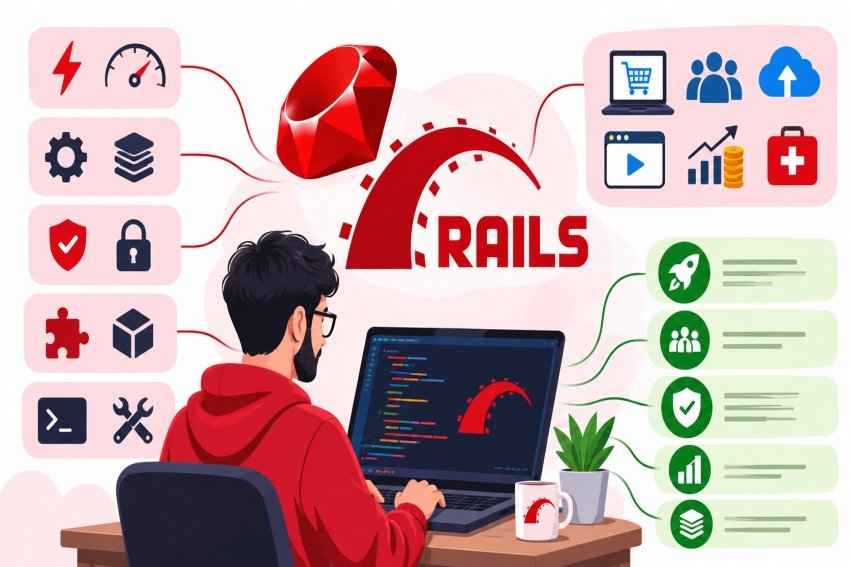
Ruby on Rails is a popular web development framework that helps businesses build powerful, scalable, and maintainable applications. It uses the Ruby programming language and provides built-in tools that simplify common development tasks. From eCommerce platforms to business management systems, Rails supports a wide range of web projects. Ruby on Rails software development is particularly useful for companies that want to launch products efficiently without sacrificing code quality. Understanding its features, applications, and advantages can help you decide whether it is the right technology for your next project.
What Is Ruby on Rails Software Development?
Ruby on Rails, often called Rails, is an open-source web application framework built with Ruby. It follows the Model-View-Controller (MVC) architecture, which separates application data, user interfaces, and request handling.
Rails also follows two important development principles:
- Convention over Configuration: Developers follow established standards instead of manually configuring every part of an application.
- Don’t Repeat Yourself (DRY): Reusable code reduces duplication and makes applications easier to maintain.
These principles help development teams build organized applications while reducing unnecessary complexity.
Key Features of Ruby on Rails
Rails offers several built-in features that simplify web application development.
1. Model-View-Controller Architecture
MVC separates an application into three components:
- Model: Manages application data and business logic.
- View: Displays information to users.
- Controller: Handles requests and connects models with views.
This structure makes applications easier to understand, test, and maintain.
2. Active Record
Active Record is Rails’ built-in Object-Relational Mapping (ORM) system. It allows developers to work with database records using Ruby objects rather than writing SQL queries for every operation.
It also supports database relationships, validations, and migrations, making data management more convenient.
3. Built-In Security Features
Rails includes tools that help developers protect applications against common security risks. These include protections and recommended practices for cross-site scripting (XSS), cross-site request forgery (CSRF), and SQL injection.
However, developers must configure authentication, authorization, and other security controls correctly.
4. Automated Testing Support
Rails provides built-in testing tools that help developers check application functionality. Automated tests can identify errors before new features reach production.
Teams can also integrate additional testing frameworks and continuous integration tools.
5. API Development
Rails supports API-only applications that deliver data through JSON responses. This makes it useful for projects that need to connect mobile applications, frontend frameworks, and third-party services.
6. Real-Time Functionality
Action Cable integrates WebSockets with Rails applications. Developers can use it to build live notifications, messaging systems, and real-time updates.
Common Uses of Ruby on Rails
Ruby on Rails supports different types of business and consumer applications.
- eCommerce Platforms: Build online stores with product catalogs, shopping carts, payment integrations, and order management.
- SaaS Applications: Develop subscription-based software with user accounts, dashboards, and business tools.
- Content Management Systems: Create platforms for publishing, editing, and organizing digital content.
- Marketplaces: Build platforms that connect buyers and sellers through listings, payments, and communication features.
- Business Management Systems: Develop custom CRM, project management, and workflow applications.
- Social Networking Platforms: Create applications with user profiles, messaging, notifications, and community features.
Rails is also suitable for developing backend systems that support mobile and web applications.
Advantages of Ruby on Rails Software Development
Choosing the right framework can influence development costs, timelines, and long-term maintenance. Here are some important advantages of Rails.
Faster Development
Rails includes ready-to-use components, generators, and conventions that reduce repetitive coding. Developers can focus more on business requirements instead of building common functionality from scratch.
Cost-Effective Development
Reusable components and faster development workflows can help control project costs. However, the actual budget depends on application complexity, integrations, team experience, and ongoing maintenance.
Scalability and Flexibility
Rails applications can support growing businesses through caching, database optimization, background processing, and additional application servers. A well-designed architecture can accommodate increasing traffic and new features.
Easier Maintenance
The framework encourages organized code and consistent development practices. This helps teams understand existing projects, fix problems, and introduce new functionality.
Strong Developer Community
Ruby on Rails has an established developer community, extensive documentation, and a large ecosystem of reusable libraries called gems. These resources make it easier to find development solutions and maintain existing applications.
Is Ruby on Rails the Right Choice for Your Project?
Rails is a strong option when you need a database-driven web application, a SaaS product, an online marketplace, or a custom business platform.
However, it is not the perfect solution for every project. Applications with highly specialized computing requirements, strict low-latency needs, or complex real-time workloads may benefit from other technologies or a different architecture.
Before choosing Rails, consider your project requirements, expected traffic, development budget, available expertise, and long-term goals.
Conclusion
Ruby on Rails offers a practical approach to building modern web applications. Its MVC architecture, Active Record, security tools, and testing support make development more organized and efficient. It is particularly valuable for startups and established businesses building SaaS platforms, marketplaces, and custom business systems. While the framework has some limitations, choosing the right architecture and experienced developers can help businesses create reliable applications that support long-term growth.
Frequently Asked Questions
1. What is Ruby on Rails used for?
Ruby on Rails is used to develop web applications, eCommerce platforms, SaaS products, online marketplaces, content management systems, and business management software.
2. Is Ruby on Rails good for startups?
Yes. Rails can help startups develop and launch products efficiently because it provides reusable components, built-in tools, and established development conventions. This can reduce repetitive development work.
3. Is Ruby on Rails scalable?
Yes. Rails applications can scale through caching, database optimization, background jobs, and additional servers. Scalability depends on application architecture, infrastructure, and development practices.
4. What is the difference between Ruby and Ruby on Rails?
Ruby is a programming language, while Ruby on Rails is a web application framework built with Ruby. Ruby provides the language, and Rails provides tools and conventions for building web applications.
5. Is Ruby on Rails still relevant in 2026?
Yes. Ruby on Rails remains actively maintained, with ongoing releases, security updates, and an established developer ecosystem. Rails 8.1.4.1 was released on November 4, 2026.