
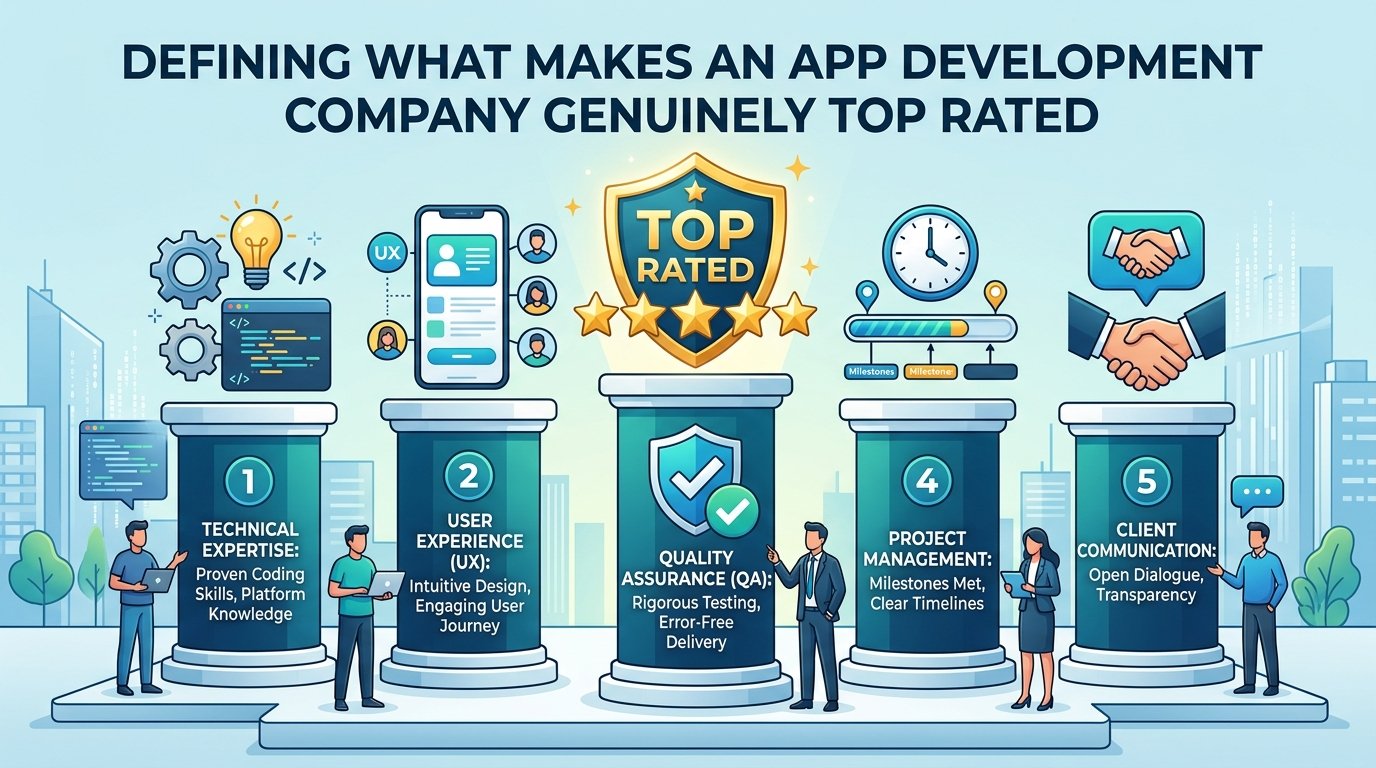
Search “top rated mobile app development company,” and the results are almost entirely rankings lists of agencies ordered by star ratings, review counts, and Clutch scores. These lists are genuinely useful as a starting point, but they rarely explain what “top rated” should actually mean, or how to tell a genuinely strong rating from one that’s been inflated, gamed, or simply built on volume rather than substance.
Understanding what actually makes a rating trustworthy, not just high, gives businesses a far more reliable basis for evaluation than scanning a list and picking whoever sits at the top.
Why a High Rating Alone Isn’t Proof of Quality
Star ratings and review counts are easy to compare at a glance, which is exactly why they’ve become the default shorthand for quality in this industry. But a rating number, on its own, compresses a huge amount of nuance into a single figure and that compression can hide real problems.
A company with a 4.9 rating built on 15 reviews tells a very different story than one with a 4.9 rating built on 300 reviews across multiple platforms. Similarly, a rating that’s consistently high across Clutch, GoodFirms, and Google Reviews independently is a stronger signal than a high score concentrated on a single platform, where verification standards and review volume can vary significantly.
What Actually Makes a Rating Trustworthy
Verified review methodology. Platforms like Clutch conduct direct interviews with clients as part of their verification process, rather than accepting self-submitted reviews at face value. A rating built on verified, interview-based feedback carries meaningfully more weight than one built on unverified submissions that anyone could post.
Consistency across independent platforms. A genuinely top-rated company tends to show similar strength across multiple review sources Clutch, GoodFirms, Google Reviews, G2 rather than an unusually high score on just one platform that isn’t reflected elsewhere.
Review volume relative to company size and history. A handful of five-star reviews is far easier to accumulate than hundreds of them sustained over years of client work. Volume, in proportion to the company’s actual track record, matters as much as the average score itself.
Specificity in the review content itself. Vague, generic praise (“great team, highly recommend”) carries less signal than reviews describing specific outcomes improved user retention, on-time delivery under a tight timeline, or a technical challenge the team solved. Specific, detailed feedback is harder to fabricate and more useful to evaluate.
Recency of reviews. A company’s rating built entirely on reviews from several years ago doesn’t necessarily reflect its current team, process, or quality. Genuinely top-rated companies tend to show a steady stream of recent reviews, not a cluster from one period followed by silence.
Beyond the Rating: What Else Genuinely Distinguishes Top Companies
A trustworthy rating is a strong starting signal, but a genuinely top-rated app development company for mobile app development typically demonstrates several qualities that don’t show up directly in a star score:
- Repeat client relationships. A high percentage of returning clients signals sustained trust that goes beyond a single successful project companies don’t tend to come back to a partner they weren’t genuinely satisfied with.
- Industry-specific experience relevant to your project. General competence matters, but genuine expertise in your specific industry healthcare, fintech, e-commerce often produces meaningfully better outcomes than broad, generalized experience alone.
- Transparent, documented case studies. Detailed case studies that explain the problem, approach, and measurable outcome carry more credibility than a portfolio that only shows finished screenshots without context.
- A structured, explainable process. Companies that can clearly walk through their discovery, design, development, and testing methodology tend to deliver more consistent results than those relying on an ad hoc approach that varies significantly by project.
Why This Framework Matters for Your Decision
Treating a star rating as the entire decision, rather than one input among several, is one of the more common mistakes businesses make when selecting a development partner. A company can be genuinely excellent without yet having accumulated hundreds of reviews, and conversely, a high aggregate score doesn’t guarantee the right fit for your specific project’s technical or industry requirements.
This is the standard Dignite Studios has built its reputation around not chasing a rating number for its own sake, but earning genuine, verified feedback through consistent delivery across more than a decade of work spanning healthcare, fintech, e-commerce, real estate, and education. The team’s approach prioritizes transparent case studies, structured process, and industry-specific experience the substance that a trustworthy rating should actually reflect, rather than treating the number itself as the end goal.
Questions to Ask Beyond the Star Rating
- Is the rating consistent across multiple independent platforms, or concentrated on just one?
- Do the reviews describe specific outcomes, or mostly generic praise?
- What percentage of the company’s clients are repeat business?
- Can they walk through detailed case studies with measurable results, not just a portfolio of screenshots?
- Does their experience align with your specific industry and technical requirements?
The Bottom Line
A genuinely top-rated mobile app development company earns that reputation through verified, consistent, specific feedback sustained over time not simply by accumulating the highest possible number on a single platform. Businesses that evaluate ratings with this level of scrutiny, rather than treating the top of a ranked list as an automatic answer, make significantly more informed decisions about who they trust to build their product.